
Daily forex signals are trade alerts that show traders when to buy or sell a currency pair. A good signal usually includes the currency pair, trade direction, entry price, stop loss, take profit levels, and a short reason for the trade.
For beginners, daily forex signals can make trading easier to understand because they provide a structured trade idea instead of leaving the trader to guess. However, forex signals should never be treated as guaranteed profit. The safest way to use them is with proper risk management, a demo account, and a trading journal.
In this guide, you will learn what daily forex signals are, how they work, how to read buy and sell alerts, which currency pairs are commonly used, how much to risk per signal, and how to avoid unreliable signal providers.
Important risk note: Forex trading involves risk. Signals are educational trade ideas, not financial advice or guaranteed profit. Always trade with money you can afford to risk.
What Are Daily Forex Signals?
Daily forex signals are trading suggestions created after market analysis. They help traders identify potential opportunities in currency pairs such as EUR/USD, GBP/USD, USD/JPY, GBP/JPY, and XAU/USD.
A forex signal does not mean the trade will win. It simply gives a structured trading idea that a trader can review, test, and decide whether to follow.
| Signal Element | What It Means | Why It Matters |
|---|---|---|
| Currency pair | The market being traded, such as EUR/USD or GBP/USD | Shows which pair to watch |
| Trade direction | Buy or Sell | Shows the expected market direction |
| Entry price | The price where the trade may be opened | Helps avoid random entries |
| Stop loss | The price where the trade should close if wrong | Controls risk |
| Take profit | The target price for closing in profit | Helps plan the reward |
| Risk-to-reward ratio | Example: 1:2 or 1:3 | Shows whether the setup is worth considering |
| Market reason | Trend, breakout, support, resistance, or news | Helps traders understand the logic |
How Daily Forex Signals Work
Daily forex signals are created when a trader, analyst, or signal provider studies the market and finds a possible setup.
The process usually works like this:
- The market is analyzed using trend, price action, support and resistance, indicators, or economic news.
- A possible trade setup is identified.
- Entry, stop loss, and take profit levels are planned.
- The signal is sent through Telegram, WhatsApp, email, app notification, or website update.
- The trader reviews the signal and decides whether to take it.
- The trader manages risk and tracks the result.
Daily forex signals can save time, but they should not replace learning. The best traders use signals as guidance while still understanding the reason behind each trade.
Example of a Daily Forex Signal
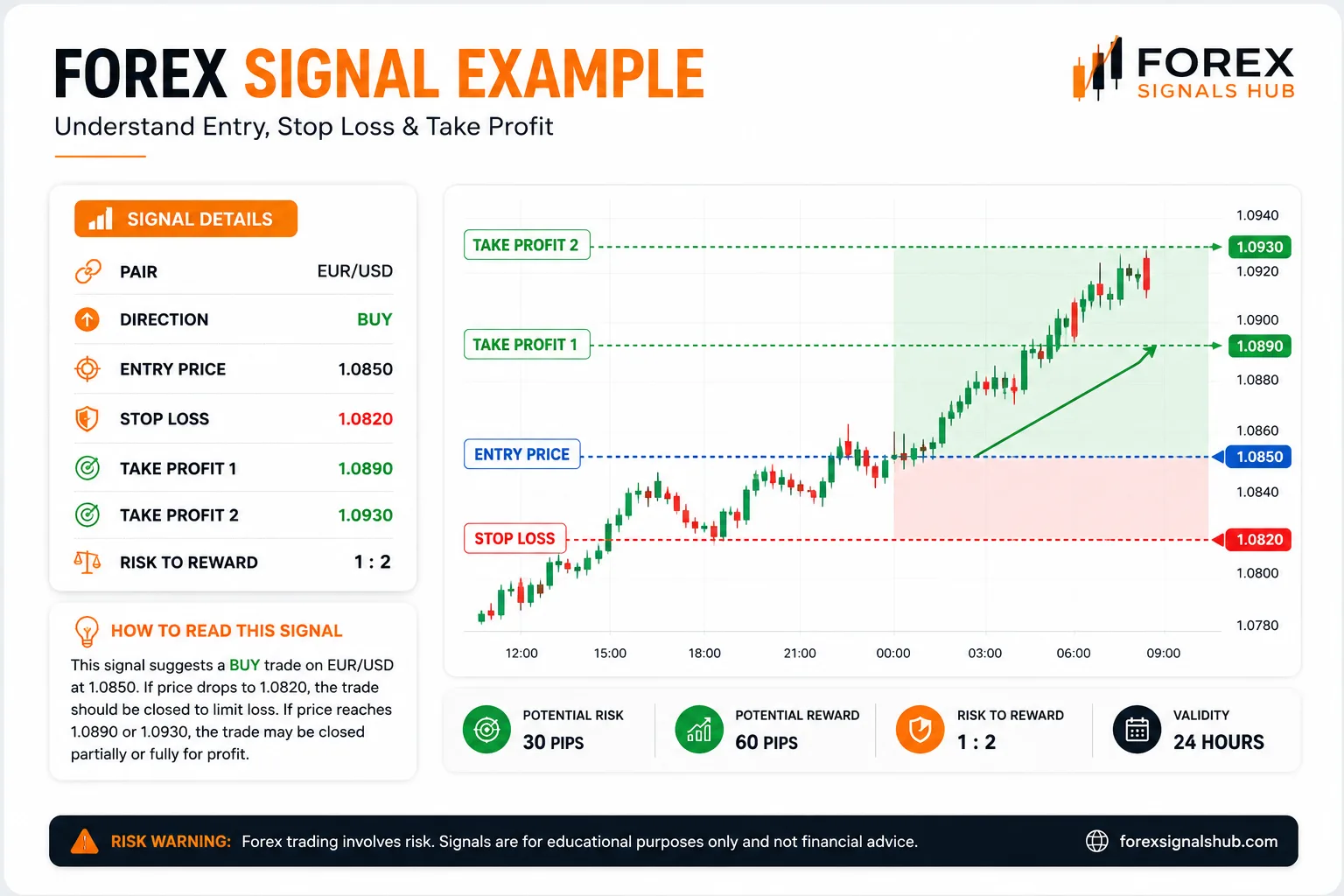
Here is a simple example of how a forex signal looks:
- Pair: EUR/USD
- Action: Buy
- Entry: 1.0850
- Stop Loss: 1.0820
- Take Profit 1: 1.0890
- Take Profit 2: 1.0930
- Risk/Reward: 1:2
This structure helps traders understand exactly where to enter and exit the trade while controlling risk.
What Makes a Good Daily Forex Signal?
A good daily forex signal is not just a random buy or sell message. It should be clear, realistic, and easy to follow.
A strong signal usually has these qualities:
| Quality | Why It Matters |
|---|---|
| Clear entry price | Helps traders avoid late entries |
| Stop loss included | Shows risk is controlled |
| Take profit levels included | Gives a planned exit |
| Realistic risk-to-reward ratio | Helps avoid poor setups |
| Short market reason | Helps traders learn from the signal |
| No guaranteed profit claim | Keeps expectations realistic |
| Consistent format | Makes signals easier to track |
Avoid signals that only say “BUY NOW” or “SELL NOW” without stop loss, take profit, or explanation.
How We Create Daily Forex Signals
At Forex Signals Hub, daily forex signals should be based on structured market analysis, not guesswork. A transparent signal process helps traders understand why a setup may be valid.
Daily signal analysis may include:
| Quality | Why It Matters |
|---|---|
| Clear entry price | Helps traders avoid late entries |
| Stop loss included | Shows risk is controlled |
| Take profit levels included | Gives a planned exit |
| Realistic risk-to-reward ratio | Helps avoid poor setups |
| Short market reason | Helps traders learn from the signal |
| No guaranteed profit claim | Keeps expectations realistic |
| Consistent format | Makes signals easier to track |
The goal is not to send as many signals as possible. The goal is to send clear trade ideas with defined risk.
Best Currency Pairs for Daily Forex Signals
Not every currency pair is suitable for every trader. Some pairs move slowly and are better for beginners. Others are more volatile and may require more experience.
| Pair | Best For | Risk Level |
|---|---|---|
| EUR/USD | Beginners and stable daily forex signals | Low to medium |
| GBP/USD | Traders who like stronger intraday movement | Medium |
| USD/JPY | Traders following USD strength and risk sentiment | Medium |
| XAU/USD | Gold traders looking for fast movement | High |
| GBP/JPY | Aggressive traders who understand volatility | High |
Beginners should usually start with major pairs such as EUR/USD or GBP/USD before trading highly volatile markets like GBP/JPY or XAU/USD.
For pair-specific signals, you can also read our guide on EUR/USD signals and gold trading signals.
Best Time to Use Daily Forex Signals
Timing matters in forex trading. Signals often work better when the market has enough liquidity and movement.
Asian Session
London Session
New York Session
London/New York Overlap
The best time to use daily forex signals is usually during the London session, New York session, or the London/New York overlap because these periods often have stronger liquidity and movement.
However, active sessions can also create fast price changes. Always check the entry price before taking a signal. If the market has already moved too far from the entry, it may be better to skip the trade.
Free vs Paid Daily Forex Signals
Both free and paid daily forex signals can be useful, but traders should understand the difference before joining any signal group.
| Type | Free Daily Forex Signals | Paid Daily Forex Signals |
|---|---|---|
| Best for | Beginners testing a provider | Traders who already tested the provider |
| Advantages | No cost, easy to join, useful for learning | More structure, more analysis, possible extra support |
| Disadvantages | May be less frequent or less detailed | Requires payment and still carries risk |
A paid signal service is not automatically better than a free one. Before paying for any signal provider, test the free signals first, review the risk management, and track both winning and losing trades.
Read our full comparison of paid vs free forex signals.
Daily Forex Signals on Telegram
Telegram is one of the most popular platforms for daily forex signals because it allows fast alerts, pinned updates, charts, and community discussion.
A good Telegram forex signal channel should provide:
- Clear buy or sell signals
- Entry, stop loss, and take profit levels
- Updates when the trade changes
- Realistic risk guidance
- No guaranteed profit claims
- Transparent results, including losses
- Educational market explanation where possible
Be careful with Telegram channels that promise fixed daily income, hide losing trades, or pressure users to upgrade quickly.
For more details, read our guide on forex signals Telegram channels.
How to Test a Daily Forex Signal Provider
Before using real money, test any forex signal provider properly.
Use this checklist:
- Test the signals on a demo account for 2–4 weeks.
- Track every signal in a trading journal.
- Check whether every signal includes a stop loss.
- Review both winning and losing trades.
- Compare the average risk-to-reward ratio.
- Avoid providers that promise guaranteed daily profit.
- Check if signals arrive before the market move, not after it.
- Watch for overtrading or too many low-quality signals.
- Make sure the provider explains at least some trade setups.
- Start small if you later move to a live account.
A reliable provider should be transparent, realistic, and consistent.
You can also read our checklist on how to choose the best forex signals provider.
Common Mistakes Traders Make With Daily Forex Signals
Many beginners do not lose because signals are always bad. They lose because they use signals incorrectly.
| Mistake | Better Approach |
|---|---|
| Copying every signal | Only take trades that fit your risk plan |
| Ignoring stop loss | Never enter without a stop loss |
| Increasing lot size after losses | Keep risk fixed and avoid revenge trading |
| Entering late | Skip the signal if price has moved too far |
| Taking too many signals | Focus on quality, not quantity |
| Expecting daily guaranteed profit | Review performance over weeks, not one day |
| Not tracking results | Use a journal to measure real performance |
Are Daily Forex Signals Profitable?
Daily forex signals can be helpful, but they are not guaranteed to be profitable.
Profitability depends on:
- Signal quality
- Market conditions
- Entry timing
- Stop loss placement
- Risk management
- Trader discipline
- Execution speed
- Spread and broker conditions
A trader can still lose money with good signals if they use oversized lots, ignore stop loss, enter late, or chase every trade.
The safest approach is to treat signals as trade ideas, not financial certainty.
Tips to Use Daily Forex Signals Effectively
- Start with a demo account first
- Risk only 1–2% per trade
- Follow signals only during active sessions
- Track every trade in a journal
- Compare multiple signals before trusting a provider
Conclusion
Daily forex signals can help traders find structured buy and sell opportunities, but they must be used carefully. A good signal includes entry, stop loss, take profit, risk-to-reward, and a clear market reason.
The best way to use daily forex signals is to start on demo, risk small, track results, and avoid any provider that promises guaranteed profit.
At Forex Signals Hub, our goal is to help traders understand signals, manage risk, and trade with more structure.
Frequently Asked Questions
Daily forex signals are buy or sell trade alerts sent to traders each day. They usually include the currency pair, entry price, stop loss, take profit targets, and market direction.
Daily forex signals can help beginners learn how trade setups are structured. However, beginners should start with a demo account, use small risk, and learn why each signal is being sent.
Free daily forex signals can be useful for testing a provider, but they are not always reliable. Avoid any free signal group that promises guaranteed profit, hides losses, or sends trades without stop loss.
A good forex signal should include the currency pair, buy or sell direction, entry price, stop loss, take profit levels, risk-to-reward ratio, and a short reason for the trade.
The best time to use daily forex signals is usually during active market sessions such as London, New York, and the London/New York overlap.
No. Forex signals cannot guarantee profit. Market conditions change, and every trade carries risk. Signals should be used with proper risk management.
There is no fixed number. Quality matters more than quantity. Beginners should avoid overtrading and only take signals that match their risk plan.
Start with free forex signals first. Test the provider, track results, and review risk management before considering any paid signal service.