What Is a Forex Signal?
EUR/USD signals are forex trading alerts that help traders identify possible buy or sell opportunities on the Euro against the U.S. Dollar. Since EUR/USD is one of the most traded currency pairs in the world, many beginners and active traders follow Euro Dollar alerts to understand price direction, entry zones, stop loss levels, and take profit targets.
However, EUR/USD signals should never be treated as guaranteed profit calls. A good forex signal is a structured trade idea. It can help you save time, understand market bias, and learn how professional traders approach the market, but proper risk management is always required.
At ForexSignalsHub, traders can follow structured forex signals through Telegram and WhatsApp, with trade alerts that focus on entry, stop loss, take profit, market explanation, and risk-to-reward planning.
What Are EUR/USD Signals?
EUR/USD signals are trading alerts for the Euro Dollar currency pair. These alerts usually suggest whether traders should consider buying or selling EUR/USD based on market analysis.
A typical EUR/USD signal may include:
Signal Detail | Example |
Currency Pair | EUR/USD |
Direction | Buy |
Entry Zone | 1.0840–1.0850 |
Stop Loss | 1.0805 |
Take Profit 1 | 1.0890 |
Take Profit 2 | 1.0930 |
Risk-to-Reward | 1:2 |
Reason | Breakout above resistance |
The goal of the signal is to give traders a clear trade idea instead of a random “buy now” or “sell now” message.
A strong EUR/USD signal should always include a stop loss. Without a stop loss, traders do not know where the trade idea becomes invalid.
Why EUR/USD Is Popular Among Forex Traders
EUR/USD is popular because it represents two of the world’s most important currencies: the Euro and the U.S. Dollar. It is known for high liquidity, tight spreads, and frequent trading opportunities.
Many traders like EUR/USD because:
- It usually has lower spreads than many minor pairs.
- It reacts clearly to major economic news.
- It is active during the London and New York sessions.
- It often respects technical levels such as support, resistance, and trendlines.
- It is suitable for both beginners and experienced traders.
Because of this, EUR/USD signals are commonly used by traders who want structured forex trading alerts on a major currency pair.
How EUR/USD Trading Alerts Work
EUR/USD trading alerts are usually created after analyzing market conditions. A signal provider may study price action, trend direction, support and resistance, liquidity zones, moving averages, market sentiment, and economic news.
For example, if EUR/USD breaks above a strong resistance level during the London session, an analyst may prepare a buy signal. If the pair rejects a resistance zone and shows bearish momentum, a sell signal may be shared.
A proper EUR/USD alert should answer five questions:
- What pair is being traded?
- Should the trader consider buying or selling?
- Where is the entry zone?
- Where is the stop loss?
- Where are the take profit targets?
This structure helps traders avoid emotional decisions.
What a Good EUR/USD Signal Should Include
Not every forex signal is useful. Some alerts only say “buy EUR/USD” or “sell EUR/USD” without explaining risk. That is not enough.
A good EUR/USD signal should include:
1. Clear Trade Direction
The signal should clearly state whether the trade idea is a buy or sell.
Example:
EUR/USD Buy Setup
or
EUR/USD Sell Setup
2. Entry Zone
The entry zone tells traders where the trade idea may be valid. This is better than entering randomly after the market has already moved.
Example:
Entry: 1.0840–1.0850
3. Stop Loss
The stop loss protects the account if the trade goes wrong. Every EUR/USD signal should include an invalidation level.
Example:
Stop Loss: 1.0805
4. Take Profit Targets
Take profit levels show where traders may close part or all of the position.
Example:
TP1: 1.0890
TP2: 1.0930
5. Market Reason
A quality signal should explain why the setup exists.
Example:
“EUR/USD is holding above previous resistance after a London session breakout. Momentum remains bullish while price stays above 1.0805.”
6. Risk-to-Reward Ratio
A good signal should have a logical risk-to-reward ratio. Many traders prefer setups where the possible reward is larger than the risk.
Example:
Risk-to-Reward: 1:2
Example of a EUR/USD Forex Signal
Here is a simple example of how a EUR/USD alert may look:
Signal Element | Example |
Pair | EUR/USD |
Type | Buy |
Entry | 1.0840–1.0850 |
Stop Loss | 1.0805 |
Take Profit 1 | 1.0890 |
Take Profit 2 | 1.0930 |
Trade Style | Intraday |
Reason | Bullish breakout above resistance |
Risk Note | Use proper lot size and avoid overleveraging |
This example is for education only. It is not a live trading recommendation.
Best Time to Use EUR/USD Signals
EUR/USD is active throughout the forex trading week, but some sessions usually provide better trading conditions.
London Session
The London session often brings strong volume and clear movement. Many EUR/USD signals appear during this period because European traders are active.
New York Session
The New York session is also important because the U.S. Dollar becomes highly active. U.S. economic news can create strong EUR/USD movement.
London-New York Overlap
The overlap between London and New York is one of the most active times for EUR/USD. Liquidity is usually higher, spreads can be tighter, and price movement may become stronger.
For many intraday traders, this overlap is one of the best times to watch Euro Dollar alerts.
Technical Analysis Used in EUR/USD Signals
EUR/USD signals can be created using different forms of technical analysis. No single method is perfect, so many traders combine multiple tools.
Support and Resistance
Support and resistance are key price areas where EUR/USD may react. Many signals form near these levels.
A buy signal may appear near support.
A sell signal may appear near resistance.
Trendlines
Trendlines help traders understand market direction. If EUR/USD is making higher highs and higher lows, the trend may be bullish. If it is making lower highs and lower lows, the trend may be bearish.
Moving Averages
Moving averages help identify trend direction. If EUR/USD trades above important moving averages, traders may look for buy opportunities. If it trades below them, traders may look for sell setups.
RSI
The Relative Strength Index can help identify overbought or oversold conditions. It can also support reversal or continuation setups.
Price Action
Price action focuses on candles, structure, momentum, and key levels. Many professional traders use price action before entering EUR/USD trades.
News and Economic Data
EUR/USD often reacts to economic events such as inflation data, interest rate decisions, employment reports, and central bank speeches. Traders should always check the economic calendar before following signals.
How Beginners Should Use Euro Dollar Alerts
Beginners should not copy EUR/USD signals blindly. Signals are most useful when they are treated as learning tools. Understanding how to read a forex signal helps traders know the entry price, stop loss, take profit targets, and risk before placing any trade.
Here is a simple process:
- Read the all signal.
- Check the entry zone.
- Confirm the stop loss.
- Review the take profit targets.
- Check the current market price.
- Avoid entering late if price has already moved.
- Use a small risk per trade.
- Record the trade in a journal.
- Study why the signal worked or failed.
This helps beginners build discipline instead of depending only on alerts.
Risk Management for EUR/USD Signals
Risk management is more important than the signal itself. Even a good setup can lose because forex trading is uncertain.
Follow these rules:
- Never risk money you cannot afford to lose.
- Use a stop loss on every trade.
- Avoid using high leverage.
- Risk only a small percentage of your account per trade.
- Do not increase lot size after a losing trade.
- Do not take every signal if the market is unclear.
- Avoid trading during major news without a plan.
- Keep a trading journal.
Many traders lose money not because every signal is bad, but because they use poor position sizing, enter late, or ignore stop losses.
Common Mistakes Traders Make with EUR/USD Signals
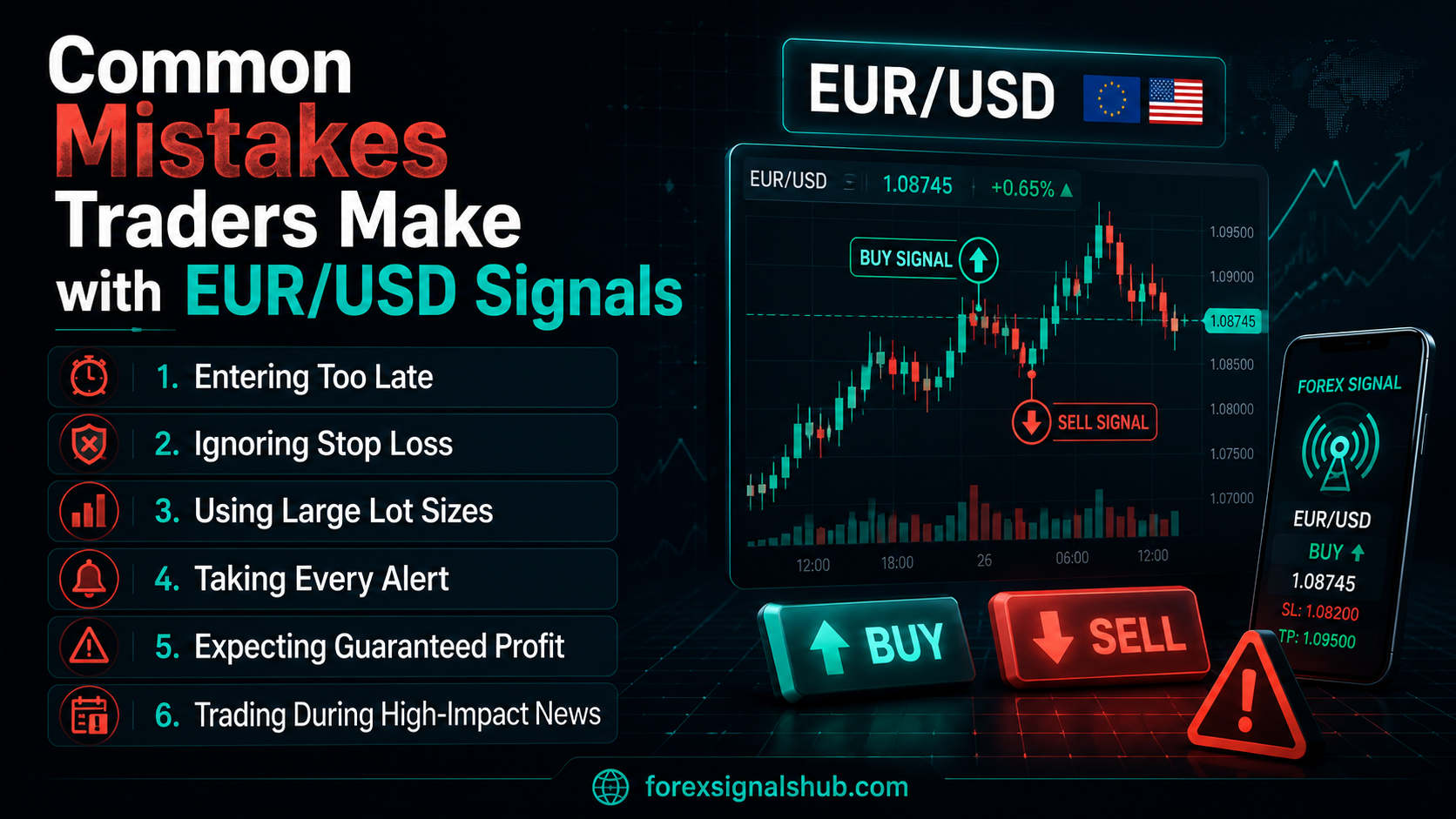
Entering Too Late
If the signal entry was 1.0840 and the price has already moved to 1.0890, the risk-to-reward may no longer be good. Chasing late entries is dangerous.
Ignoring Stop Loss
A stop loss shows where the trade idea is wrong. Ignoring it can turn a small loss into a major account problem.
Using Large Lot Sizes
Beginners often overtrade because EUR/USD has tight spreads. But tight spreads do not remove risk. Lot size must match account size.
Taking Every Alert
Not every signal fits every trader. Some traders prefer intraday setups, while others prefer swing trades. Choose signals that match your trading style.
Expecting Guaranteed Profit
No EUR/USD signal provider can guarantee profits. Forex signals are trade ideas, not guaranteed results.
Trading During High-Impact News
EUR/USD can move sharply during news events. Beginners should be careful around major announcements.
Free vs Paid EUR/USD Signals
Both free and paid EUR/USD signals can be useful, depending on the trader’s goal.
Feature | Free EUR/USD Signals | Paid EUR/USD Signals |
Cost | Free | Subscription-based |
Detail | Usually basic | Often more detailed |
Speed | May be slower | Usually faster |
Support | Limited | More support |
Education | Basic | More structured |
Risk Notes | Sometimes included | Usually included |
Free signals can help beginners understand how trade alerts work. Paid signals may offer more structure, analysis, faster updates, and better support.
However, paid does not automatically mean better. Traders should always check transparency, risk management, and signal quality before joining any service.
Why Use ForexSignalsHub for Forex Signals?
ForexSignalsHub is built around structured trading alerts, real-time market intelligence, and community-based learning. The site explains that its alerts include entry zones, stop loss, take profit levels, risk-to-reward guidance, and market explanation, delivered through Telegram and WhatsApp.
This is important because traders need more than just “buy” or “sell” messages. They need context.
A strong forex signal service should help traders understand:
- Why the setup matters
- Where the trade becomes invalid
- Where profits may be taken
- How risk should be managed
- What market conditions support the idea
That is why beginners should focus on structured alerts, education, and discipline instead of chasing unrealistic profit claims.
FAQs
What are EUR/USD signals?
EUR/USD signals are forex trading alerts that suggest possible buy or sell opportunities on the Euro against the U.S. Dollar. They usually include entry, stop loss, take profit, and market analysis.
Are EUR/USD signals good for beginners?
Yes, beginners can use EUR/USD signals as learning tools. However, they should start small, use stop loss, and understand the reason behind each trade.
Can EUR/USD signals guarantee profit?
No. No forex signal can guarantee profit. Signals are trade ideas based on analysis, and all trading involves risk.
What should a EUR/USD signal include?
A good EUR/USD signal should include the currency pair, direction, entry zone, stop loss, take profit targets, risk-to-reward ratio, and a short market explanation.
What is the best time to trade EUR/USD signals?
The London session, New York session, and London-New York overlap are often active periods for EUR/USD trading. However, traders should also watch economic news.