
Forex trading is the buying of one currency while selling another to profit from changes in exchange rates. Currencies are traded in pairs such as EUR/USD, GBP/USD, and USD/JPY. Beginners should understand currency pairs, pips, leverage, risk management, and trading signals before risking real money.
Forex is one of the largest financial markets in the world, but it is also risky. Many beginners enter the market expecting fast profits without understanding how price movement, leverage, stop loss, and risk management work.
In this beginner guide, you will learn what forex trading is, how it works, the most important forex terms common beginner mistakes,
What Is Forex Trading and How Does It Work
What Is Forex Trading?
Forex trading, also called foreign exchange trading or FX trading, is the process of exchanging one currency for another. Traders try to profit from changes in currency prices.
For example, if you believe the euro will rise against the US dollar, you may buy EUR/USD. If the price moves higher, you may make a profit. If the price moves lower, you may lose money.
Forex trading happens through currency pairs. You are not buying one currency alone. You are always buying one currency and selling another at the same time.
Example:
- EUR/USD
- GBP/USD
- USD/JPY
- AUD/USD
- USD/CAD
In the EUR/USD pair, EUR is the euro and USD is the US dollar. If EUR/USD moves higher, it means the euro is getting stronger against the US dollar. If EUR/USD moves lower, it means the euro is getting weaker against the US dollar.
How Does Forex Trading Work?
Forex trading works by speculating on whether one currency will rise or fall against another.
Every forex pair has two parts:
Term | Meaning | Example |
Base currency | The first currency in the pair | EUR in EUR/USD |
Quote currency | The second currency in the pair | USD in EUR/USD |
If EUR/USD is trading at 1.1000, it means 1 euro is worth 1.1000 US dollars.
If a trader buys EUR/USD at 1.1000 and the price rises to 1.1050, the trader gains 50 pips. If the price falls to 1.0950, the trader loses 50 pips.
Simple EUR/USD Example
Imagine EUR/USD is trading at 1.1000.
You think the euro will strengthen against the US dollar, so you place a buy trade.
Trade detail | Example |
Currency pair | EUR/USD |
Trade direction | Buy |
Entry price | 1.1000 |
Take profit | 1.1050 |
Stop loss | 1.0970 |
If price moves from 1.1000 to 1.1050, your trade reaches take profit.
If price moves from 1.1000 to 1.0970, your trade hits stop loss.
This is why risk management is important. A profitable forex trader does not only think about how much they can make. They also plan how much they can lose if the trade goes wrong.
What Is the Forex Market?
The forex market is the global marketplace where currencies are traded. It is used by banks, governments, institutions, businesses, investors, and retail traders.
Unlike the stock market, forex does not trade from one central exchange. It is a decentralized market, which means trading happens electronically through a global network of banks, brokers, and liquidity providers.
The forex market is open 24 hours a day, 5 days a week.
The main forex trading sessions are:
Trading session | Main region | Beginner note |
Sydney session | Australia | Lower volatility compared with London/New York |
Tokyo session | Asia | Important for JPY pairs |
London session | Europe | High liquidity and strong market movement |
New York session | United States | Strong movement, especially during overlap with London |
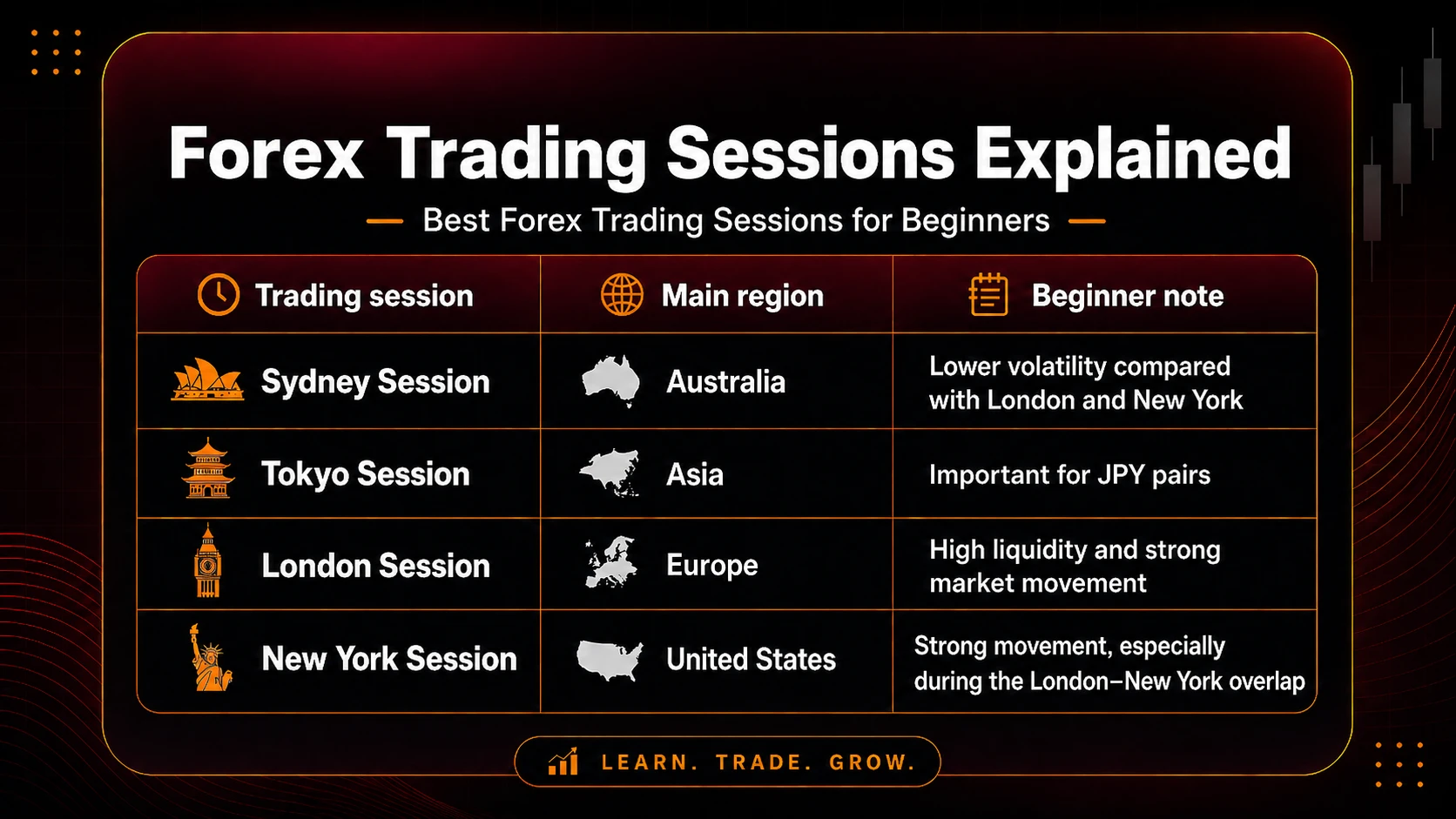
The London and New York overlap is often one of the most active times in the forex market. Many traders focus on this period because major currency pairs can move strongly during this session.
Major Currency Pairs Beginners Should Know
A currency pair shows the value of one currency compared with another. Beginners usually start with major pairs because they often have higher liquidity and tighter spreads.
Currency pair | Full name | Beginner note |
EUR/USD | Euro vs US dollar | Most popular forex pair |
GBP/USD | British pound vs US dollar | Can be more volatile than EUR/USD |
USD/JPY | US dollar vs Japanese yen | Often reacts to risk sentiment and interest rates |
USD/CAD | US dollar vs Canadian dollar | Can be affected by oil prices and US/CAD news |
AUD/USD | Australian dollar vs US dollar | Often affected by commodities and China-related data |
USD/CHF | US dollar vs Swiss franc | Sometimes seen as a safe-haven pair |
For beginners, EUR/USD is often easier to study because it is highly liquid and has many educational examples available.
What Is a Pip in Forex?
A pip is a small unit of price movement in forex trading. It helps traders measure how much a currency pair has moved.
For most major forex pairs, one pip is usually the fourth decimal place.
Example:
If EUR/USD moves from 1.1000 to 1.1005, that is a 5-pip move.
If EUR/USD moves from 1.1000 to 1.1050, that is a 50-pip move.
|
|
|
|
|
|
|
|
For JPY pairs, pips are usually measured differently because the price format is different.
Example:
If USD/JPY moves from 150.00 to 150.10, that is a 10-pip move.
Understanding pips is important because your profit, loss, stop loss, and take profit are often calculated in pips.
What Is Spread in Forex?
Spread is the difference between the buy price and the sell price of a currency pair.
For example, if EUR/USD has:
- Buy price: 1.1002
- Sell price: 1.1000
The spread is 2 pips.
The spread is one of the main trading costs in forex. Lower spreads are usually better for traders, especially beginners and short-term traders.
Major pairs like EUR/USD often have tighter spreads than exotic pairs because they have more liquidity.
What Is Lot Size in Forex?
Lot size means the size of your trade. It controls how much money you gain or lose for every pip movement.
Common forex lot sizes include:
Lot type | Units | Beginner note |
Standard lot | 100,000 units | High risk for small accounts |
Mini lot | 10,000 units | Lower risk than standard lot |
Micro lot | 1,000 units | More beginner-friendly |
Nano lot | 100 units | Useful for very small accounts, if available |
Many beginners lose money because they use lot sizes that are too large for their account. A small market move can cause a big loss if the lot size is too high.
What Is Leverage in Forex Trading?
Leverage allows traders to control a larger position with a smaller amount of money.
For example, with 1:100 leverage, a trader may control a $10,000 position with only $100 of margin.
This may sound attractive, but leverage is risky. It can increase profits, but it can also increase losses.
Beginner Warning
Leverage does not make trading safer. It increases exposure. If the market moves against you, losses can happen quickly.
Beginners should avoid using high leverage and should always use a stop loss. It is better to trade small and protect your account than to risk too much on one trade.
What Is Margin in Forex?
Margin is the amount of money required to open a leveraged trade.
If your broker requires $100 margin to open a trade, that $100 is set aside while the trade is active. If the market moves against you and your account balance becomes too low, your broker may close your trade automatically. This is called a margin call or stop out.
Margin is closely connected to leverage. The more leverage you use, the less margin you may need to open a trade, but the risk can become higher.
Benefits of Forex Trading
Forex trading attracts many beginners because it offers flexibility and access to global currency markets.
Some benefits include:
1. 24-Hour Market
The forex market is open 24 hours a day from Monday to Friday. This gives traders flexibility to trade during different sessions.
2. High Liquidity
Major forex pairs usually have high liquidity, which means there are many buyers and sellers in the market.
3. Ability to Buy or Sell
Forex traders can buy if they think a currency pair will rise or sell if they think it will fall.
4. Low Starting Capital
Some brokers allow traders to open small accounts and trade micro lots. However, starting with small capital does not remove risk.
5. Many Learning Resources
Beginners can study charts, market news, trading strategies, and forex signals to learn how trade setups work.
How Beginners Can Start Forex Trading Safely
If you are new to forex trading, do not rush into live trading. Follow a safe learning process.
Step 1: Learn the Basics
Start by understanding currency pairs, pips, spread, leverage, margin, and lot size.
Step 2: Open a Demo Account
A demo account allows you to practice without risking real money.
Step 3: Choose a Regulated Broker
Use a broker that is properly regulated and transparent about trading costs, spreads, and withdrawals.
Step 4: Learn Risk Management
Do not risk too much on one trade. Many beginners use the 1% rule, which means risking only 1% of account balance on a single trade.
Step 5: Practice Reading Charts
Learn basic support and resistance, trend direction, candlestick behavior, and market sessions.
Step 6: Understand Forex Signals
Forex signals can help you learn how trade ideas are structured, but you should understand the signal before following it.
Step 7: Start Small
Only move to live trading when you have practiced enough and understand the risks.
Common Beginner Forex Trading Mistakes
Many beginners lose money because they make the same mistakes repeatedly.
1. Trading Without a Plan
A trade should have a clear entry, stop loss, take profit, and reason.
2. Using High Leverage
High leverage can destroy a small account quickly.
3. Ignoring Stop Loss
A stop loss helps limit losses when the market moves against you.
4. Chasing Every Signal
Not every signal is worth taking. Beginners should check risk, timing, and market conditions.
5. Trading During Major News Without Experience
News events can cause sudden price spikes. Beginners should be careful around major economic releases.
6. Expecting Guaranteed Profit
Forex trading does not guarantee income. Anyone promising guaranteed profit should be treated with caution.
7. Risking Too Much on One Trade
Risking a large percentage of your account on one trade can lead to fast losses.
Can You Make Money from Forex Trading?
The safest way to learn forex trading is to start with education and demo practice before risking real money.
Many beginners ask about forex trading profit per day, but daily profit is never guaranteed. Your results depend on your account size, strategy, risk management, lot size, leverage, and market conditions.
Here is a beginner-friendly learning path:
Stage 1: Learn forex basics
Stage 2: Study currency pairs, pips, and spreads
Stage 3: Practice on demo account
Stage 4: Learn risk management
Stage 5: Study forex signals and trade examples
Stage 6: Start small if moving to live trading
Stage 7: Track every trade in a journal
A trading journal is important because it helps you understand your mistakes. Write down why you entered a trade, where your stop loss was, what happened, and what you learned.
Conclusion
Forex trading is the buying and selling of currencies to profit from exchange-rate movements. It can be exciting and flexible, but it is also risky. Beginners should learn how currency pairs, pips, leverage, margin, lot size, and risk management work before trading with real money.
Forex signals can help beginners understand how trade setups are structured, but they should never be treated as guaranteed profit. A good signal includes entry, stop loss, take profit, and risk guidance.
The best approach is to learn first, practice on demo, manage risk, and use signals as educational support instead of blindly following every trade idea.
Frequently Asked Questions
Forex trading works through currency pairs. Traders buy a pair if they think the base currency will rise against the quote currency, or sell a pair if they think the base currency will fall.
Yes, some traders make money from forex trading, but many beginners lose money because they trade without a plan, use high leverage, or ignore risk management. Profit is never guaranteed.
EUR/USD is often considered one of the best forex pairs for beginners because it is highly liquid, widely followed, and usually has lower spreads than many other pairs.
Yes, $100 is enough to start forex trading, but it is best used for learning, practice, and small position sizes. With a $100 account, beginners should avoid high leverage, use micro lots if available, and risk only a small amount per trade.
The 3-5-7 rule is a risk management idea, not an official forex rule. It usually means limiting risk across trades: risk about 3% on one trade, 5% total across open trades, and 7% total account exposure. Beginners may use even lower risk, such as 1% per trade.